In this article
- What line items belong in a laminated shingle roof replacement Xactimate estimate?
- Are laminated roof shingles the same as architectural shingles?
- How does Florida's 25% rule affect your laminated shingle replacement scope?
- How do you move from raw roof photos to a carrier-ready PDF without losing days?
- How should you manage adjuster revisions and short scopes on laminated shingle claims?
- How Storm Xactimate handles this for you
- Frequently Asked Questions
Scoping a laminated shingle replacement in Xactimate comes down to capturing every square, linear foot, and accessory needed to build the roof back to code. The core scope centers on removing the damaged roofing (RFG ARL) and installing laminated architectural shingles (RFG ARLS or RFG ARL), both billed by the square (SQ). Missing the peripheral components, however, drains profit fast. Starter strip, drip edge, ridge cap, and valley underlayment must all be matched to the local price list to reflect real-world material costs.
During storm season, speed matters as much as accuracy. Roofing contractors stay ahead of production backlogs by bundling field measurements, pitch gauge photos, and local building code requirements into an adjuster-ready PDF upfront. Clean documentation settles claims faster and keeps crews moving. Source: Storm Xactimate.
What line items belong in a laminated shingle roof replacement Xactimate estimate?
Under Verisk Xactimate item code reference standards (RFG category), a proper scope pairs exact unit measurements with the correct roofing assemblies. Primary line items cover the main surface area:
- RFG ARL: Tear-off of existing laminated shingles (SQ)
- RFG ARL or RFG ARLS: Installation of new architectural shingles (SQ)
- RFG STR: Universal starter course along eaves and rakes (LF)
- RFG DRIP: Perimeter drip edge (LF)
- RFG RIDGC: Laminated or profile-matched ridge cap (LF)
- RFG VAL: Valley barrier / ice and water shield (SF)
Beyond component codes, calculate waste based on the actual roof geometry. A simple gable roof might need only 10% waste, but cut-up hip roofs with multiple valleys, dormers, and varying pitches quickly drive that requirement to 15% or higher. Include steep-pitch charges (e.g., 7/12 to 9/12 or 10/12 to 12/12) and high-roof access fees wherever the architecture warrants them. Finally, if the scope involves complex coordination across three or more separate trades, apply General Contractor Overhead and Profit (O&P).
Are laminated roof shingles the same as architectural shingles?
Yes. In the roofing trade, "laminated" and "architectural" refer to the same dimensional asphalt shingle, manufactured by bonding two or more fiberglass-asphalt mats together. Both differ fundamentally from traditional, single-layer 3-tab strip shingles.
In Xactimate, this distinction makes a substantial financial difference. Selecting a standard 3-tab code (RFG 220) instead of a laminated shingle (RFG ARL) depresses both the Replacement Cost Value (RCV) and Actual Cash Value (ACV) materials allowance across the entire job.
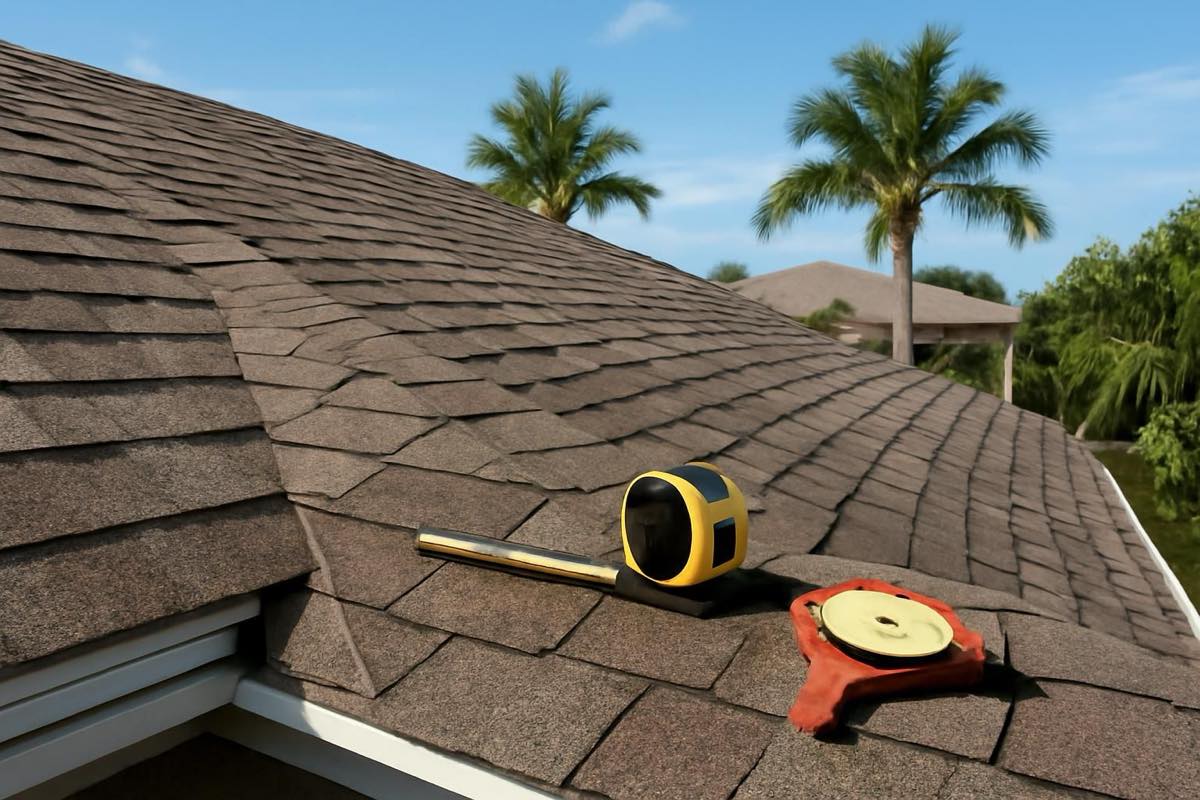
To justify RFG ARL, have your crews photograph the shingle profile from the edge. A crisp close-up showing the laminated multi-layer tab construction gives adjusters indisputable proof that the property does not have a basic 3-tab roof.
How does Florida's 25% rule affect your laminated shingle replacement scope?
In Florida, storm-related spot repairs frequently trigger full re-roofs because of building codes. Under the Florida Building Code Existing Building provisions, if more than 25 percent of a roof section or roof covering is repaired, replaced, or recovered within any 12-month window, the entire roof covering must be brought into compliance with current code standards.
Once documented storm damage crosses this 25% mark, add mandatory upgrade line items directly to your estimate alongside the standard tear-off and replacement:
- Secondary water barrier: Sealed roof deck applications (self-adhering modified bitumen tape over deck seams or full-deck underlayment).
- Perimeter fastening: Enhanced nail patterns along eaves and rakes to meet regional wind-speed requirements.
- Drip edge sizing: Sizing that complies with current overlap and hem requirements.
Always confirm specific enforcement nuances with the local municipal building department, as authorities having jurisdiction (AHJs) can enforce local amendments.
How do you move from raw roof photos to a carrier-ready PDF without losing days?
The storm season bottleneck usually strikes behind a desk. Contractors sign contingency agreements in the field, then wait days for an in-house estimator to run numbers—or lose deals outright because they lack Xactimate seats.
Fixing this requires standardizing field intake. Train sales reps to upload pitch gauge photos, shingle thickness shots, eave measurements, and property data into one structured file. Pair those photos with measurement reports from EagleView, Hover, or GAF QuickMeasure to bypass manual roof sketches entirely.
Adjusters approve files faster when they receive organized roof diagrams, labelled photo sheets, and clear line items compiled under your company header. When you eliminate manual data entry and stop fighting complex ESX files, your team spends its time closing deals rather than writing estimates.
How should you manage adjuster revisions and short scopes on laminated shingle claims?
When an adjuster's initial scope comes back short, skip the argumentative emails. Lay their statement of loss side-by-side against your original estimate and isolate the exact variances: an under-calculated waste percentage, omitted starter course linear footage, or missed drip edge allowances.
Compile those delta items into a clean supplement packet. Pair each missing line item with a photo or diagram verifying the field condition. If you are operating within a standard 30-day revision window, submit the adjuster’s summary sheet with targeted line-item notes that address the omissions point-by-point.
Keep the narrative objective. Focus purely on measurable dimensions, manufacturer installation requirements, and adopted local codes. Documenting physical facts protects your credibility and keeps you safely within contractor boundaries without crossing into unauthorized public adjusting.
How Storm Xactimate handles this for you
Storm Xactimate provides residential roofing contractors with carrier-ready Xactimate estimates built for insurance restoration. Simply submit your job details, inspection photos, and an existing aerial measurement report; if you do not have a report, Storm Xactimate orders one for the property. Every estimate is written on the local, monthly updated price list and reviewed by an experienced estimator within 24 hours of receiving complete job data.
You receive a complete PDF package featuring your company branding, full roof diagrams, and formatted photo sheets. If the carrier adjuster pushes back or leaves critical items off their scope, submit their estimate within 30 days to receive an included revision round. Start an estimate with Storm Xactimate, or review credit packages on the pricing page.
Frequently Asked Questions
What is a laminated shingle roof? A laminated shingle roof uses multi-layered asphalt shingles, commonly called architectural or dimensional shingles. Unlike flat, single-layer 3-tab shingles, laminated shingles are built with two or more fiberglass-asphalt mats fused together, providing greater dimensional depth, higher wind ratings, and longer warranties.
Are laminate shingles the same as asphalt shingles? Laminate shingles are one type of asphalt shingle. While all laminate shingles are asphalt products, not all asphalt roofs are laminated. Traditional 3-tab shingles consist of a single, flat layer of asphalt, whereas laminated shingles use a multi-layered construction.
What is the 25% rule for roofing? Under the Florida Building Code (Existing Building provisions), repairing or replacing more than 25 percent of a roof section or covering within a 12-month period mandates bringing the entire roof covering up to the current building code. Specific requirements should always be confirmed with the local building department.
Do I need my own Xactimate license to order estimates? No. Storm Xactimate produces professional estimates for contractors who do not have an active Xactimate license or internal estimating team. You provide field photos and dimensions; our team prepares the completed PDF under your company logo.