In this article
- What Florida statutes and building codes govern a wind damage roof claim?
- Notice of claim timelines under Florida law
- Florida Building Code (FBC) mandatory installation requirements
- Why do carrier adjusters short-scope Florida shingle wind claims?
- Missing auxiliary line items
- Repair vs. replacement scope friction
- How should a roofing contractor document wind damage for faster review?
- Standardized photo capture sequencing
- Pairing aerial measurement with field photos
- How do you handle line-item supplements without legal action?
- Reconciling the carrier scope against true job costs
- Justifying Overhead and Profit (O&P) and code items
- How Storm Xactimate handles this for you
- Frequently Asked Questions About Florida Wind Roof Claims
- What is the statute of limitations for filing a wind damage roof claim in Florida?
- Can a roofing contractor negotiate an insurance claim with State Farm in Florida?
- Why do carrier estimates leave out drip edge and starter strip?
- How does waste percentage factor into a Florida shingle wind claim?
A Florida wind damage roof claim succeeds on technical documentation, not legal threats or vague storm reports. Desk and field adjusters routinely short-scope laminated shingle roofs, skipping mandatory code items and basic installation accessories—starter strip, drip edge, valley ice-and-water barrier, and realistic waste factors. Winning approval for an accurate scope means tying clear photographic proof directly to local building requirements and current Xactimate pricing.
Speed and clarity protect cash flow during storm season. Contractors can bridge the gap between field damage and carrier scope approvals without acting as unlicensed public adjusters, interpreting policy coverage, or crossing legal lines. Delivering a clean, line-item Xactimate estimate that speaks the adjuster’s language—backed by undisputed building codes and aerial measurements—gets the job done. Source: Storm Xactimate.
What Florida statutes and building codes govern a wind damage roof claim?
Operating in the 2026 storm environment leaves little room for error. When desk adjusters look for reasons to cut line items or kick back supplements, grounding your scope in statutory deadlines and Florida Building Code (FBC) mandates stops delays before they start.
Notice of claim timelines under Florida law
Homeowners and contractors face rigid statutory deadlines. Under Florida Statute § 627.70132, initial property insurance claims for windstorm or hurricane damage must be reported within one year of the date of loss. Reopened or supplemental claims must be filed within 18 months.
Because the window for submitting a supplement is tight, turnaround time dictates cash flow. Waiting weeks to order aerial measurements, assemble photo sheets, and build an estimate puts the job at risk. When an under-scoped carrier estimate arrives, the line-item supplement needs to be ready to go immediately.
Florida Building Code (FBC) mandatory installation requirements
Field adjusters often write estimates that overlook the 8th Edition (2023) Florida Building Code - Residential, Chapter 9. Your estimate must demand compliance.
When stripping a damaged roof, the FBC mandates specific replacement practices:
- Drip Edge: An approved drip edge installed along eaves and rakes with code-compliant overlap.
- Valleys: A self-adhering, polymer-modified bitumen sheet (ice and water barrier) installed beneath the main roof covering.
- Underlayment: A sealed underlayment system over the entire roof deck to prevent water intrusion.
When an adjuster writes a scope paying only for the surface shingles (SQ) but omits the linear feet (LF) of drip edge or the square footage (SF) of required underlayment, the estimate is fundamentally defective.
Why do carrier adjusters short-scope Florida shingle wind claims?
Carrier desk and field adjusters—handling files for Citizens, State Farm, or regional carriers—lean heavily on macro-generated templates. These templates systematically strip out components essential to code-compliant laminated shingle tear-offs and replacements.
Missing auxiliary line items
A basic carrier scope frequently covers only field shingles in squares (SQ). Missing are starter course (LF), ridge cap (LF), drip edge (LF), valley lining, pipe boots, and proper waste calculations.
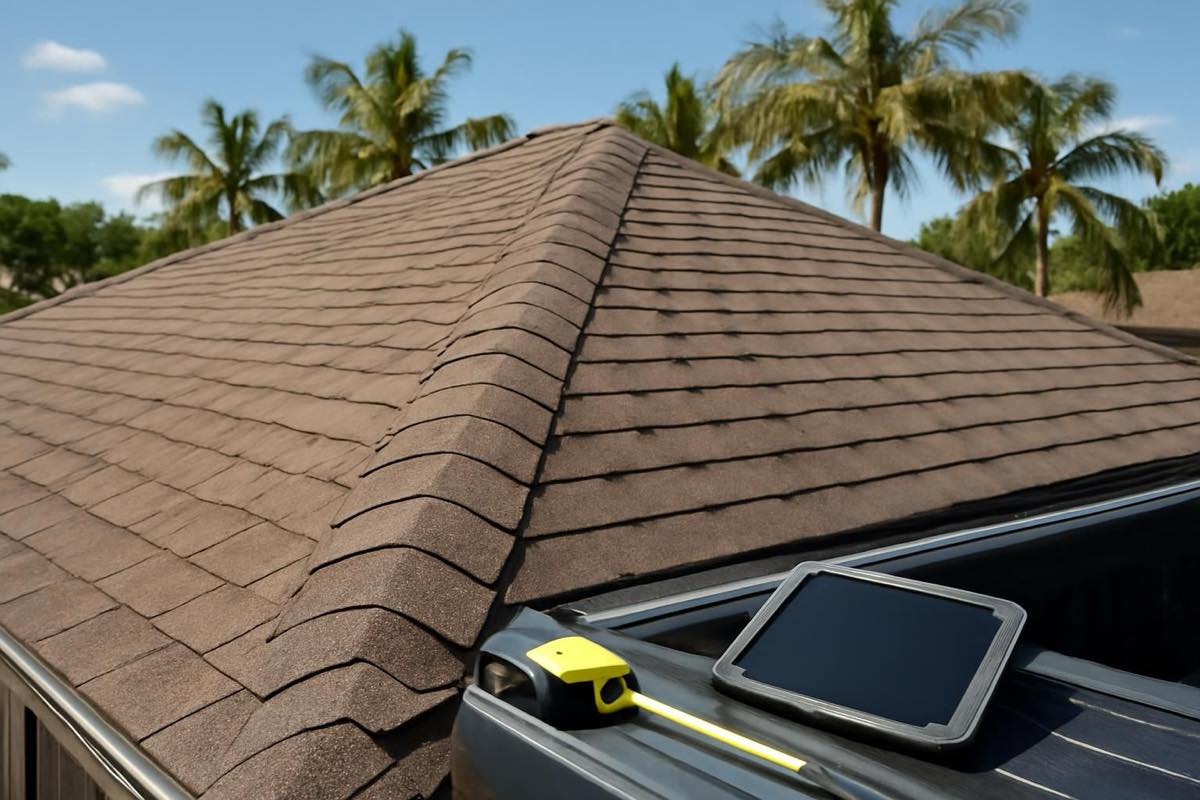
Waste remains a constant battleground. Adjusters often default to a flat 10% across the board. Yet real-world scrap depends on hip-to-valley geometry and roof pitch. A steep hip roof cut up by dormers, pitch transitions, and multiple valleys requires extensive cutting and fitting. The waste percentage must reflect that geometry—often pushing well past 10%—to ensure the crew does not come up short.
Repair vs. replacement scope friction
Adjusters frequently push for spot repairs over full replacements. But when wind uplift unseals or creases laminated shingles across multiple facets, tab repairs fail.
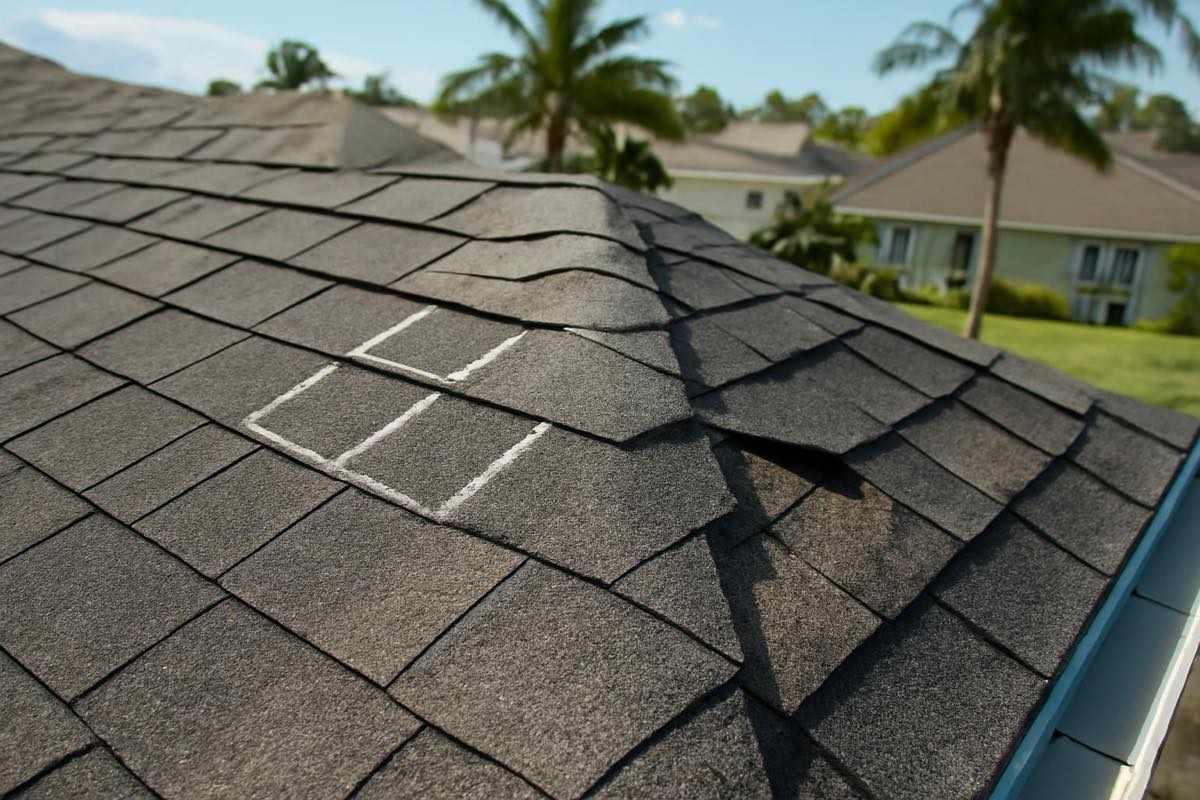
High winds break the factory sealant bond, allowing windborne dirt and debris to blow into the sealant line and permanently prevent resealing. Nailing in a replacement shingle requires lifting the course above, which breaks that course's bond too. On brittle or steep-pitch shingles, this manipulation causes cascading damage. Isolated spot repairs become structurally and technically impractical. The scope must clearly document unsealed and creased shingles across the whole facet to defend a complete replacement.
How should a roofing contractor document wind damage for faster review?
A desk adjuster cannot approve what they cannot see. Disorganized photo reports guarantee rejected supplements.
Standardized photo capture sequencing
Structure photo intake logically, facet by facet. Start with clear pitch gauge photos to verify roof steepness, followed by wide slope views for context.
Next, chalk out 10x10 test squares. Inside these squares, highlight unsealed and creased laminated shingles. Take macro close-ups of lifted windward tabs showing broken sealant lines and debris intrusion, using chalk arrows to point directly to damage marks.
Capture the perimeter with equal care. Take detailed photos of blown-off ridge cap and torn perimeter starter. These images supply the physical proof needed for the starter and ridge cap line items routinely omitted from carrier scopes.
Pairing aerial measurement with field photos
Desk adjusters easily confuse rakes, eaves, valleys, and hips when clicking through hundreds of pictures. Tie field photos directly to an aerial measurement report from EagleView, Hover, or GAF QuickMeasure to eliminate the confusion.
Match photo sheet labels to the aerial report. If the Hover report identifies the front right slope as "Facet 3," label the corresponding test square photos "Facet 3." This clear correlation proves the dimensions and damage exist on the exact same plane, cutting off any claim that the damage is isolated to a non-contiguous area.
How do you handle line-item supplements without legal action?
Roofing contractors are not public adjusters. You cannot negotiate coverage, interpret policy language, or argue legal theories for the homeowner. Handle line-item disputes on the merits of technical installation standards and actual job costs.
Reconciling the carrier scope against true job costs
When the carrier's paperwork arrives, line it up directly against an estimate built from the local Florida monthly price list in Xactimate. Identify every omission.
Document the exact variance between your actual job costs and the carrier's figures—including Actual Cash Value (ACV), Replacement Cost Value (RCV), and net claim payouts. Flag where the carrier missed linear footage for starter and drip edge, or where they pulled an outdated price list for the property's zip code.
Justifying Overhead and Profit (O&P) and code items
Complex reroofs often warrant Overhead and Profit (O&P). When a project requires coordinating multiple trades—such as roofing, gutter replacement, exterior painting, drywall repair, and window screens—O&P applies.
Justify O&P and missing code items by attaching manufacturer installation specifications and local building code references. Keep combative language out of supplement notes. Provide a clean Xactimate PDF, organized photos, and the technical backup required to approve the supplement. While an ESX file can occasionally speed up review, a clean PDF backed by code references is your primary tool for securing full RCV.
How Storm Xactimate handles this for you
Storm Xactimate builds carrier-ready Xactimate roof estimates for residential roofing contractors.
To get started, upload the job details: insured and claim information, roof specifications, field photos, and the adjuster's scope if available. If you have an EagleView, Hover, or GAF QuickMeasure report, include it. If not, Storm Xactimate orders it—aerial measurement is included in the service.
Estimates are written in Xactimate using the current local price list, and every file is reviewed by a professional estimator before delivery. Turnaround is within 24 hours of a complete order (aerial measurement plus minimum photos). Required code items—such as drip edge, valley ice and water barrier, starter course, and O&P—are applied wherever field evidence warrants them.
The final deliverable includes the estimate PDF, roof diagrams, and organized photo sheets branded with your company name and logo. If the adjuster pushes back, upload their estimate or response letter within 30 days of delivery for one included revision or supplement round. Order status updates in real time through every stage: Received, Measuring, Building, Review, and Delivered.
Start an estimate with Storm Xactimate.
Frequently Asked Questions About Florida Wind Roof Claims
What is the statute of limitations for filing a wind damage roof claim in Florida?
Under Florida Statute § 627.70132, initial property insurance claims for windstorm or hurricane damage must be reported within one year of the date of loss. Reopened or supplemental claims must be filed within 18 months of the date of loss.
Can a roofing contractor negotiate an insurance claim with State Farm in Florida?
No. In Florida, roofing contractors cannot act as public adjusters or negotiate coverage, policy terms, or financial settlements on behalf of the homeowner. Contractors provide objective scopes, line-item estimates, and photographic damage documentation reflecting required construction practices.
Why do carrier estimates leave out drip edge and starter strip?
Carrier field adjusters frequently rely on broad-brush templates or simplified repair scopes that omit perimeter accessories. Contractors must supply line items for drip edge (LF) and starter (LF) supported by photos showing perimeter tear-off and Florida Building Code requirements.
How does waste percentage factor into a Florida shingle wind claim?
Waste accounts for cutting shingles along valleys, hips, rakes, and pitch transitions. Standard gable roofs may carry 10% waste, while complex hip roofs with multiple valleys, dormers, and steep pitches can require 15% to 20% waste to ensure full coverage.