In this article
- What is the Florida Building Code 25 percent roof replacement rule today?
- What is the difference between direct damage and repair work under the 12-month rule?
- How do you document roof section areas for an Xactimate supplement?
- Which Xactimate line items should you write to avoid scope gaps?
- Core Roofing and Code Items
- Accessories and Flashing
- How can contractors track cumulative repairs across a 12-month window?
- How Storm Xactimate handles this for you
- What are the most common questions about the Florida roof replacement rule?
- What is the new law in Florida about roofs?
- Can I get my roof replaced for free in Florida?
- Does the 25 percent rule apply if shingles are discontinued?
Under the Florida Building Code (Existing Building, Section 706.1.1), repairing, replacing, or recovering more than 25 percent of a roof section within any 12-month period mandates bringing that entire section up to current code—which usually means tearing it off completely. Senate Bill 4-D (codified in Florida Statute § 553.844) introduced a critical carve-out: roofs built or replaced under the 2007 Florida Building Code or later only need code-compliant repairs, exempting them from automatic full replacement.
For roofing contractors, proving a scope meets the replacement threshold requires exact square footage (SF) or square (SQ) calculations per slope. Direct storm damage is only half the story; you also have to document the tear-out area needed to tie in the new field shingles. Getting an insurer to approve the full section requires clean Xactimate line items backed by detailed field photos and aerial measurements.
Source: Storm Xactimate.
What is the Florida Building Code 25 percent roof replacement rule today?
Applying the 25 percent rule in the field requires knowing how the building code defines a work area. Chapter 2 of the Florida Building Code defines a "roof section" as a distinct portion of the roof bounded by intersecting planes, walls, parapets, edges, ridges, valleys, or hips.
The 25 percent threshold applies per roof section—not across the entire structure. If an isolated 10 SQ facet sustains wind damage on a 50 SQ roof, your calculation covers only that 10 SQ facet. The condition of the remaining 40 SQ does not dilute the percentage.
The 2022 legislative reforms changed residential roofing claims across Florida. For systems permitted and installed on or after March 1, 2009—the effective date of the 2007 FBC—the automatic full-section replacement mandate no longer applies by default. If the surrounding shingles are structurally sound and repairable, the carrier only owes for a spot repair to code.
Full replacement still applies in two common scenarios:
- The roof predates the March 1, 2009 cutoff.
- Cumulative repairs on an individual facet exceed 25 percent within a rolling 12-month window.
What is the difference between direct damage and repair work under the 12-month rule?
Friction between contractors and desk adjusters often comes down to impact area versus actual repair footprint. Direct storm damage is simple to spot. A high-wind event might tear off 5 SQ of laminated shingles across a 15 SQ slope.
The true repair area, however, expands the moment the crew starts tear-out.
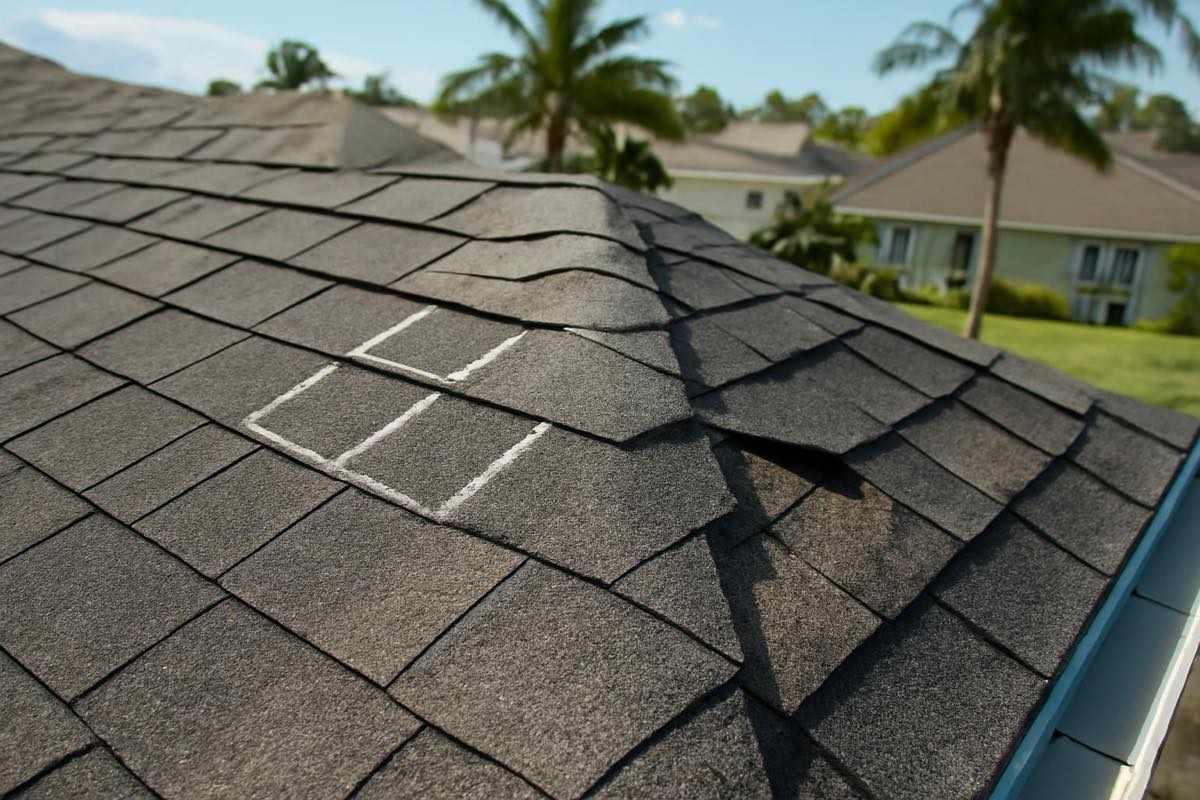
Replacing 20 SF of wind-creased shingles frequently requires stripping 60 SF of undamaged material back to the rakes or ridge cap to weave courses properly. You must account for nail-line exposure, stepped tear-outs, and valley tie-ins. When older shingles are brittle, lifting them to set fasteners underneath often snaps the tabs, expanding the repair footprint further.
That total disturbed area—not just the storm-torn shingles—counts toward the 25 percent threshold on that slope over a rolling 12-month period.
Adjusters often rely on initial tape measurements that capture only the perimeter of missing shingles. Your documentation must show the true operational boundary. By pairing close-up damage photos with aerial reports from EagleView, Hover, or GAF QuickMeasure, you can substantiate the full square footage required to execute the repair correctly. Demonstrating that a targeted patch job requires tearing into a third of the slope establishes that the project crosses the legal threshold for section replacement.
How do you document roof section areas for an Xactimate supplement?
Desk adjusters process hundreds of ESX files during peak storm season. Disorganized files sit at the bottom of the pile. To prove a roof section qualifies for full replacement, break down aerial reports into individual facets by exact square footage and pitch. Never base your argument on whole-roof square counts.
Photo evidence must tell an undeniable story:
- Wide-angle overviews: Show the entire plane of the affected slope to establish context.
- Chalked close-ups: Clearly mark wind-creased, torn, or lifted shingles.
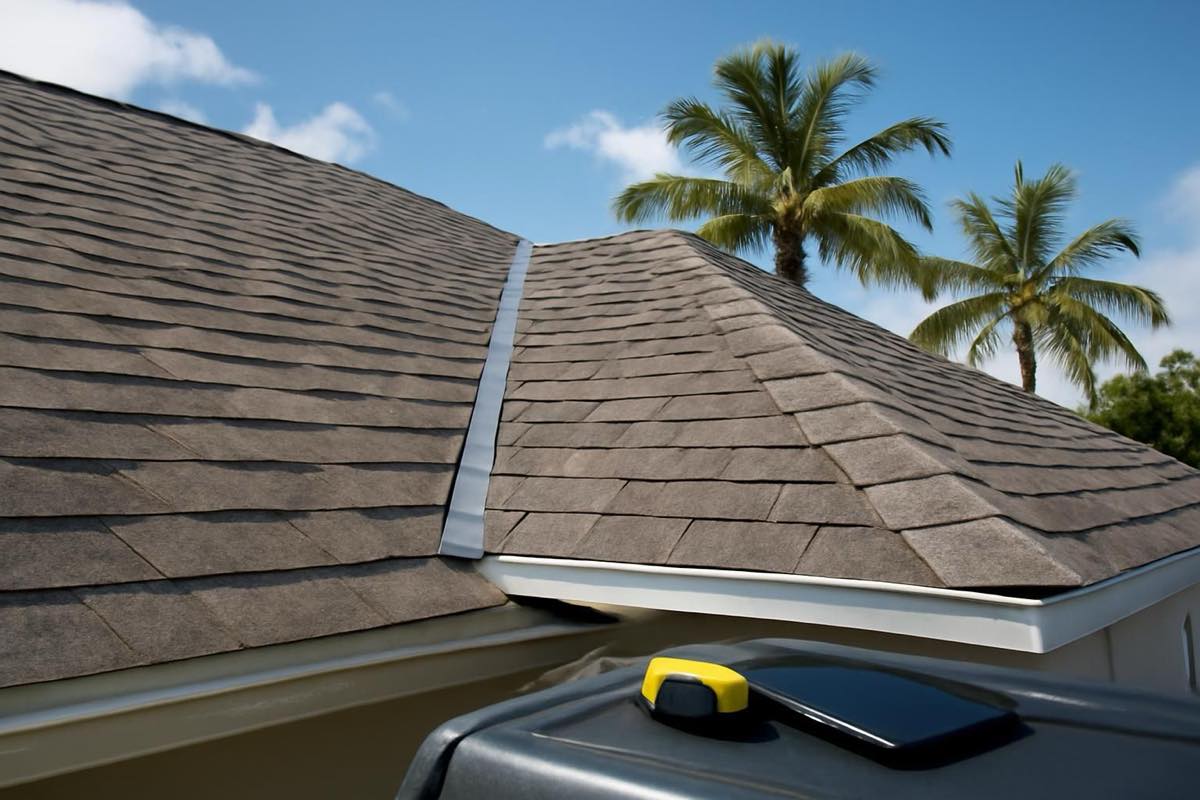
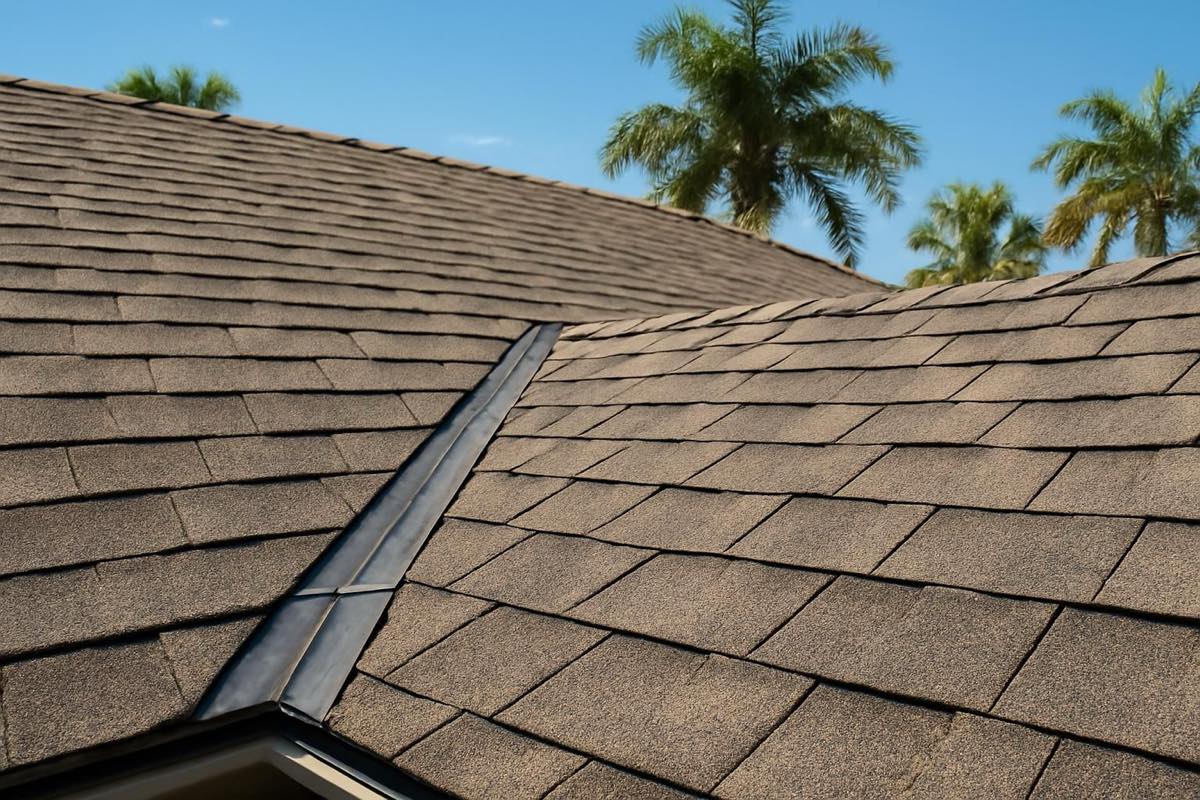
- Transition points: Detail tie-in conditions at valleys, hips, rakes, and ridges where tie-ins inevitably damage adjacent materials.
Calculate the exact percentage directly on the roof plan:
$$\left(\frac{\text{Total Repair Area SF}}{\text{Total Roof Section SF}}\right) \times 100$$
When submitting your supplement package, assemble the items into a single, cohesive file:
- An updated roof diagram highlighting the specific facet
- Manufacturer documentation (brittle test failures or discontinued shingle notices)
- Relevant Florida Building Code citations
- The revised ESX estimate file
Which Xactimate line items should you write to avoid scope gaps?
Missing line items force you to absorb material costs or waste weeks fighting supplemental disputes. When a roof section requires full replacement, capture every component on the estimate.
Core Roofing and Code Items
- Shingles: Select the proper grade—
RFG 240(3-tab),RFG 300(architectural/laminated), orRFG 400(premium heavy-weight). - Steep Charges & Waste: Add steep charges for slopes over 6/12 pitch. Set waste factors between 10 and 15 percent depending on hip and valley complexity.
- Drip Edge (
RFG DRIP): Quantify perimeter drip edge in linear feet (LF), required by the Florida Building Code along eaves and rakes. - Underlayment (
RFG FELTorRFG IWS): Include code-mandated ice and water shield or self-adhering modified bitumen underlayment in valleys and around penetrations.
Accessories and Flashing
- Starter Course (
RFG STRTR): Eaves and rakes. - Ridge Cap (
RFG RIDGC): Peaks and hips. - Step Flashing (
RFG FLASHST): Wall intersections, dormers, and chimneys. - Penetrations: Individual line items for pipe jacks and exhaust vents.
When multiple trades are required—such as roofing, gutter work, exterior stucco repair, or interior drywall patching—apply Overhead and Profit (O&P). Add standard 10 & 10 to the Replacement Cost Value (RCV) summary to cover the management and coordination of distinct subcontractors.
How can contractors track cumulative repairs across a 12-month window?
The 25 percent rule operates on a rolling 365-day clock. Past repairs completed earlier in the year count toward the threshold if a new storm hits the same section.
Ask homeowners about previous work during your first site visit, then verify the history through local building department records.
The math compounds quickly. A 10 percent patch completed five months ago combined with a new 16 percent wind repair equals 26 percent total work on that slope. That isolated facet now crosses the legal replacement threshold.
To submit a cumulative claim, present a clean paper trail: past permit records, previous scopes of work, and your current measurement reports showing the combined percentage. Note that Storm Xactimate does not pull permits, and permit fees are not added automatically without documentation; verify local permitting requirements and municipal fees directly with the building official.
How Storm Xactimate handles this for you
Storm Xactimate creates carrier-ready Xactimate estimates for residential roofing contractors managing Florida storm claims. Simply upload the job details, field photos, and claim data. If you do not have an EagleView, Hover, or GAF QuickMeasure report, Storm Xactimate orders it directly.
Every line item is written using the property’s regional price list, reviewed by a professional estimator, and delivered as an ESX file and PDF report within 24 hours of completing the order. We operate on a straightforward pay-per-estimate model: purchase credits upfront and apply them as jobs come in, keeping your overhead predictable. Review the pricing section to see the structure.
When Florida Building Code mandates a full section replacement, our team incorporates every required code item—drip edge, starter strip, valley membranes, ridge caps—and adds O&P when multi-trade work justifies it. If an adjuster returns a short scope, you have a 30-day window to submit their estimate for an included revision. Start an estimate with Storm Xactimate today.
What are the most common questions about the Florida roof replacement rule?
What is the new law in Florida about roofs?
Recent legislation, specifically Senate Bill 4-D and House Bill 837, revised how property claims are handled. SB 4-D amended Florida Building Code Section 706.1.1, allowing roofs installed under the 2007 FBC (or later) to be repaired to code rather than requiring automatic replacement. HB 837 largely eliminated one-way attorney fees and restricted Assignment of Benefits (AOB) agreements, shifting how contractors write estimates and communicate coverage to owners. Review the Florida Legislature for current statutory text.
Can I get my roof replaced for free in Florida?
No. Waiving, absorbing, or rebating an insurance deductible is a felony under Florida law. Policyholders are legally required to pay their deductible out of pocket.
Storm Xactimate is an estimating service, not a public adjusting firm. We do not negotiate claims, interpret policy terms, or guarantee insurance payouts. Contractors and homeowners must handle all Actual Cash Value (ACV) and Replacement Cost Value (RCV) disbursements according to policy terms.
Does the 25 percent rule apply if shingles are discontinued?
A discontinued shingle is a repairability and matching issue, not a 25 percent building code trigger. Under Florida matching laws, insurers must provide a reasonably uniform appearance across adjoining areas. If an exact replacement shingle is unavailable, even a small 10 percent repair can justify full replacement based on appearance and physical feasibility. Moreover, if working around brittle, discontinued shingles breaks adjacent materials during installation, the active repair footprint often expands past the 25 percent mark on its own.